ACT-V
Vision and position
A wrist image and six follower joint positions provide the reference input.
Master's thesis / 2026
Learning Contact Representations from Zero-Cost Proprioceptive Effort Signals for Contact-Rich Visuomotor Imitation Learning
Near contact, similar camera images can require different actions. A peg may be aligned with the hole, pressing on its rim, or beginning to jam. Force and tactile sensors can expose these states, but they add hardware and integration work.
The ST3215 servos on the SO-101 already report motor current. The reading costs nothing to add to the observation, but gravity, motion, gearbox friction, grasp load, and contact can all affect it.
Physical rollouts
Individual recordings make the observed behaviour tangible. They illustrate the aggregate comparisons below and are not paired trials.
01 / Signal characterisation
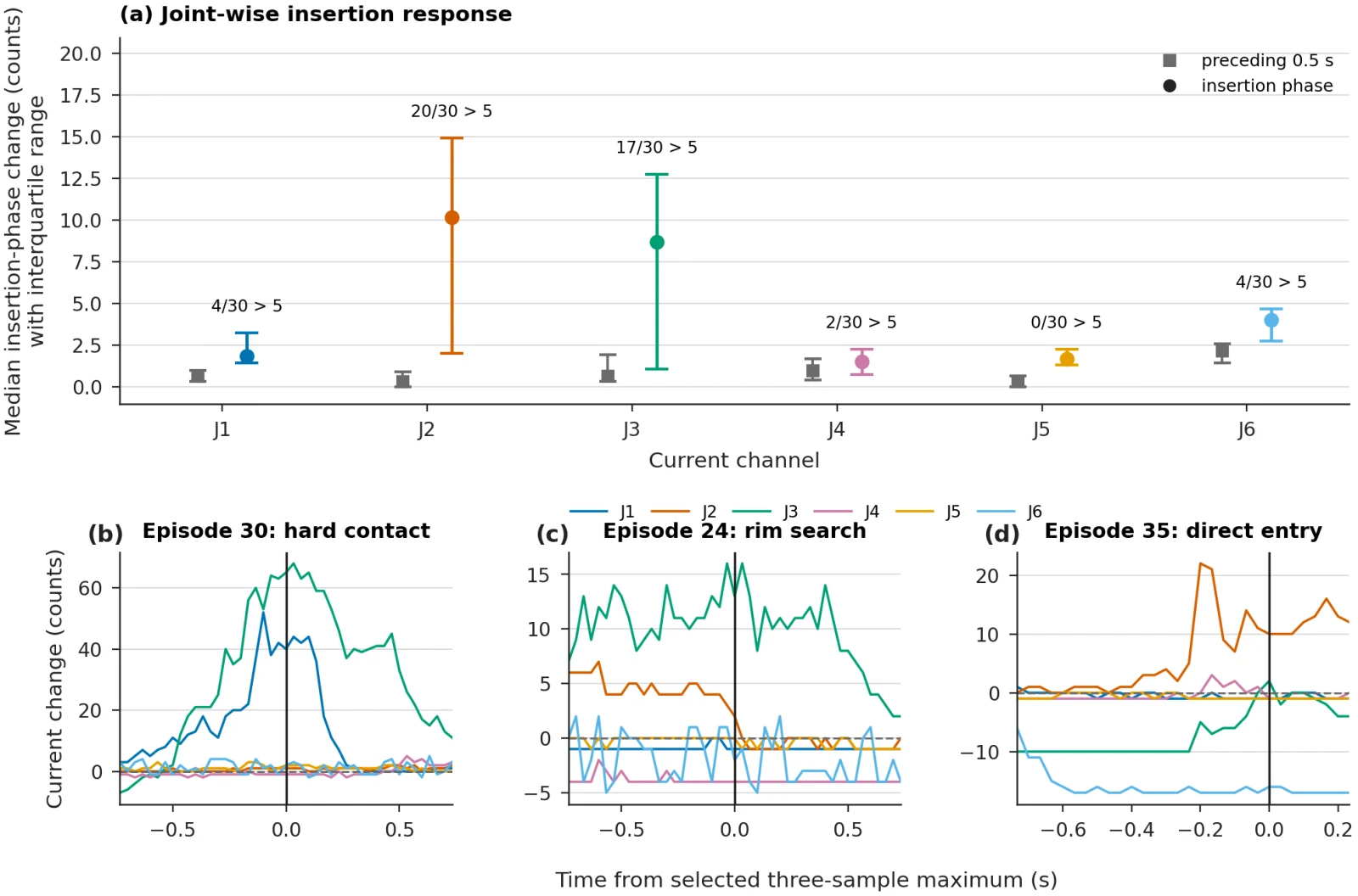
The six servo-current channels were examined under static poses, known loads, scripted grasps, natural motion, and reviewed insertion phases.
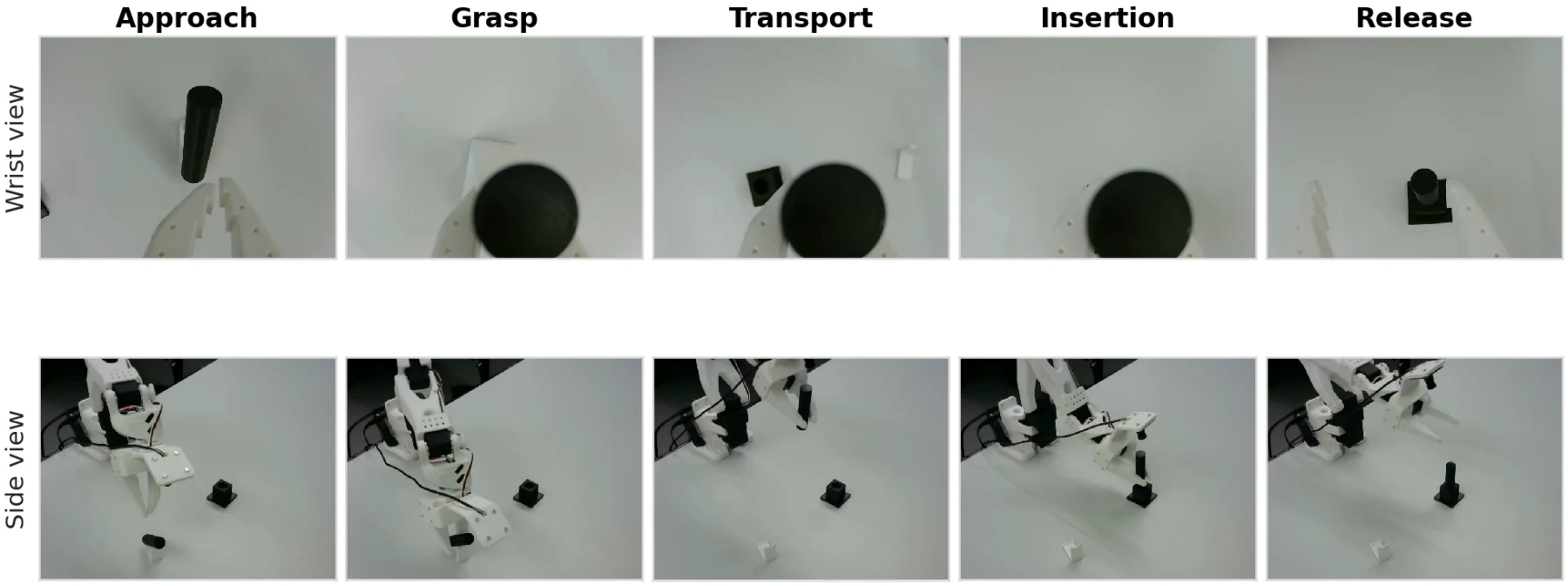
One hundred vertical peg-in-hole demonstrations were collected through leader-follower teleoperation.
The policy views retain identical episodes, frame indices, images, timestamps, and action targets. Only the state input changes. Current caps and normalization statistics are fitted on training demonstrations alone.
03 / Policy inputs
The controlled comparisons keep episodes, frames, images, timestamps, and action targets fixed. Only the state view changes.
ACT-V
A wrist image and six follower joint positions provide the reference input.
ACT direct
Six instantaneous current values are scaled with training-derived statistics and appended to the state vector.
ACT temporal
A shared one-dimensional convolutional encoder maps each current history to a joint-specific representation.
Diffusion Policy
A temporal current route conditions a frozen vision and position base through bounded residual modulation.
04 / Model response
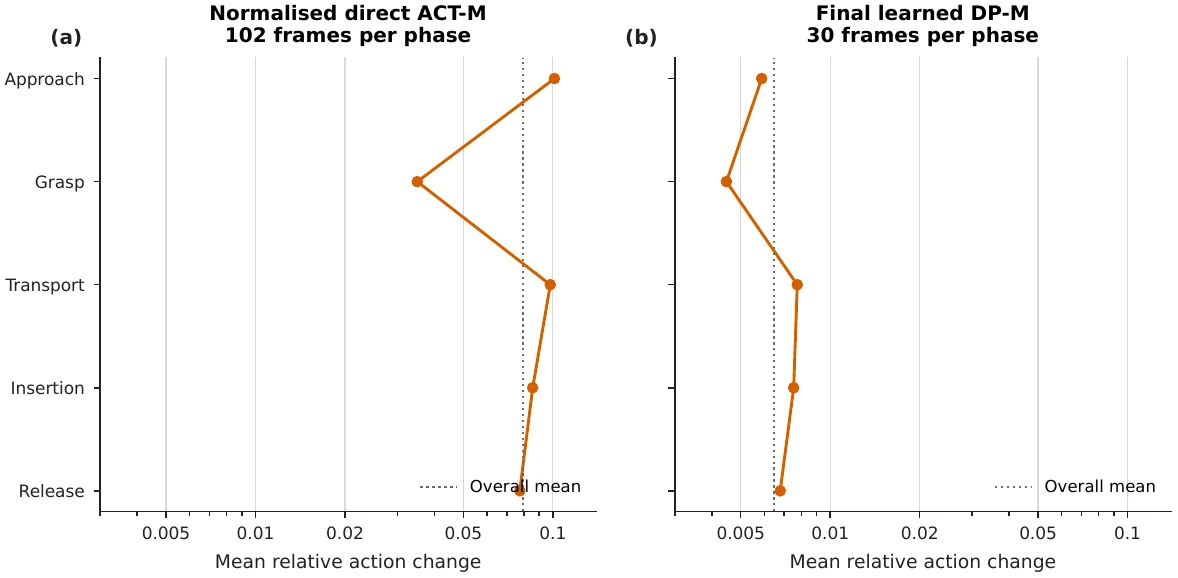
Current is replaced with its training mean while image and joint position remain fixed. The action change measures checkpoint sensitivity to the added modality.
05 / Closed-loop evaluation
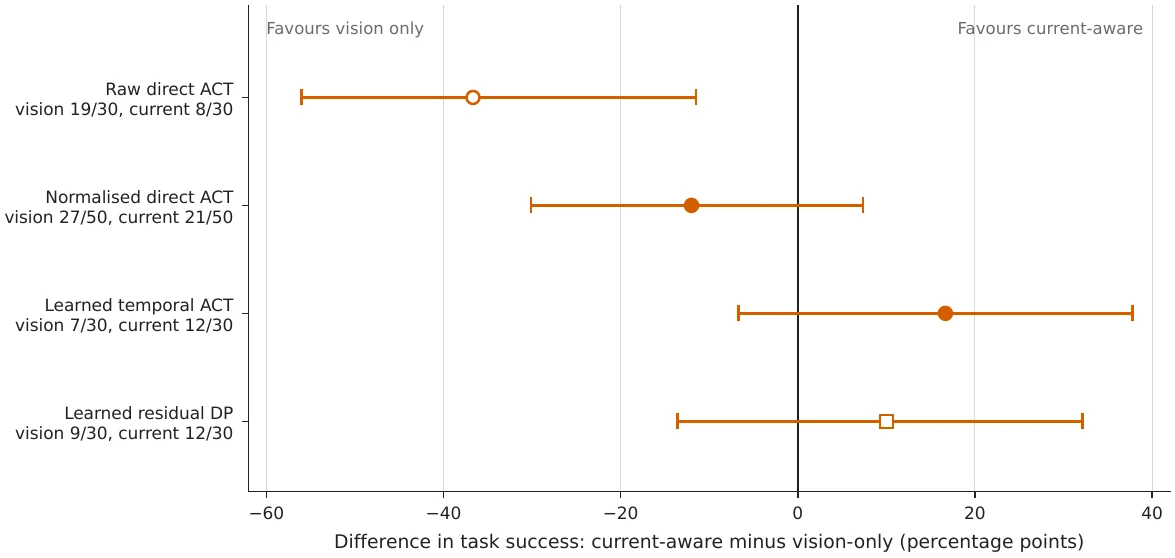
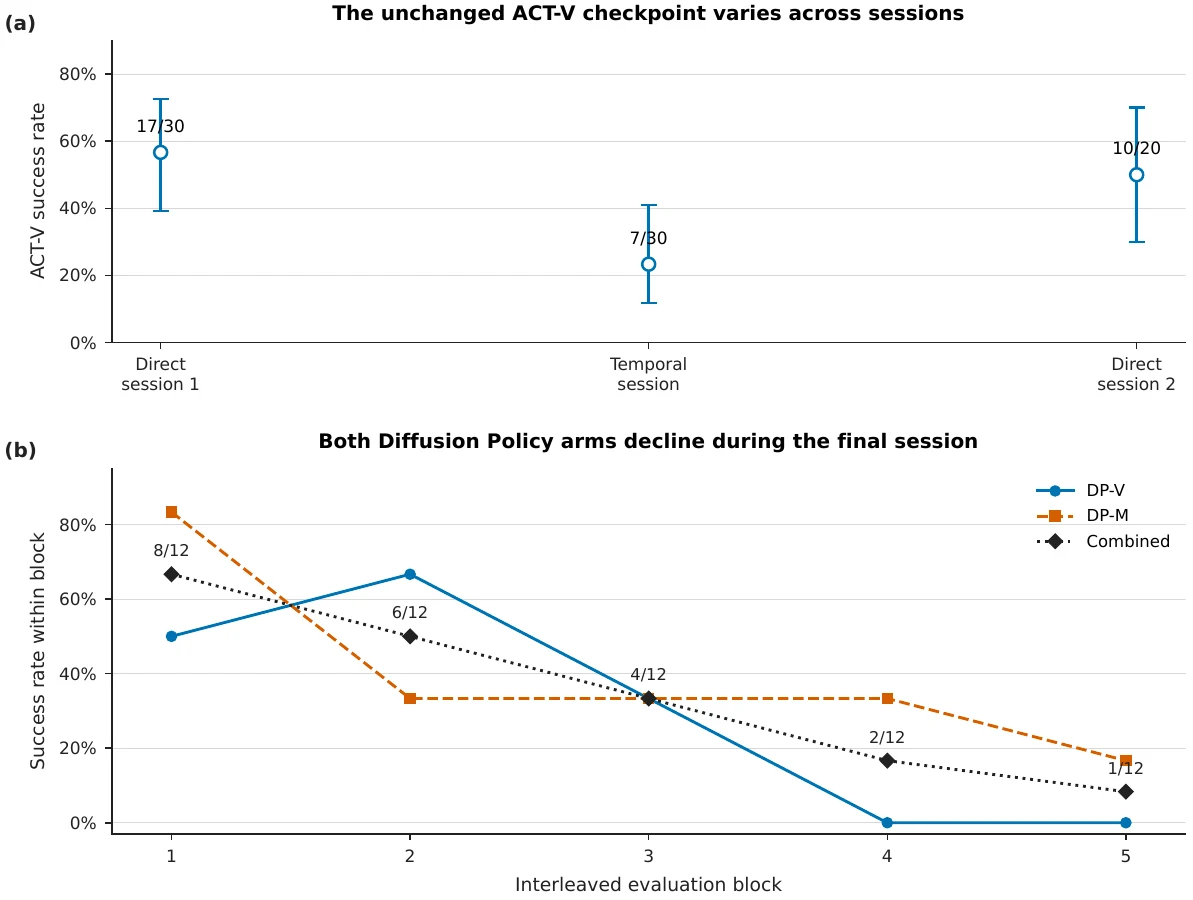
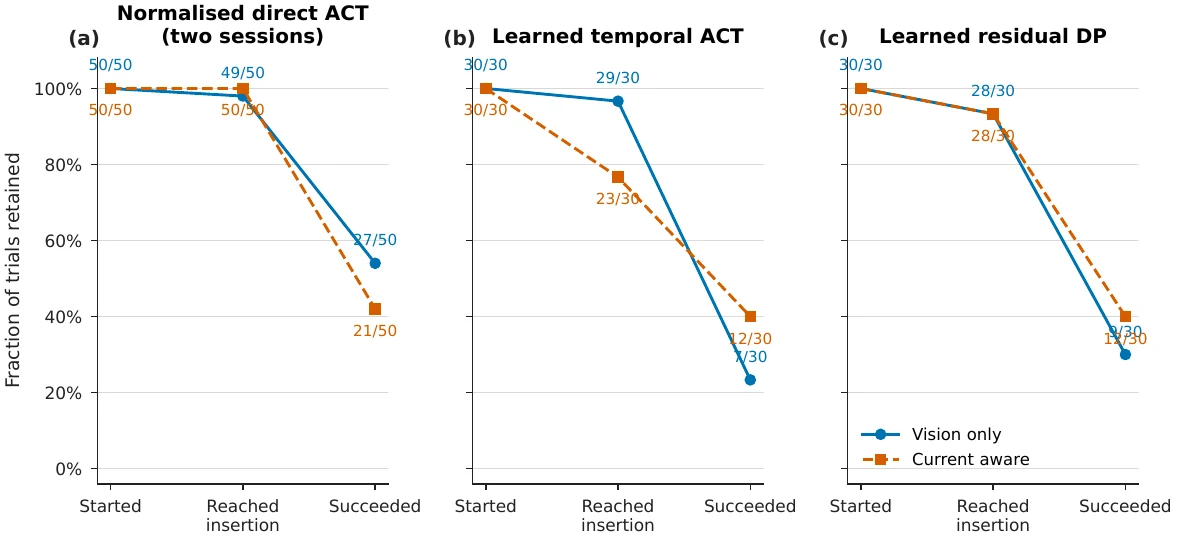
Success requires the peg to be fully seated and flush before timeout. Each effect is the current-aware success rate minus its contemporaneous vision-only rate.
| Comparison | Vision only | Current aware | Difference, percentage points (95% CI) |
|---|---|---|---|
| Raw direct ACT | 19/30 | 8/30 | −36.7 [−56.0, −11.5] |
| Normalized direct ACT, two sessions | 27/50 | 21/50 | −12.0 [−30.1, 7.4] |
| Learned temporal ACT | 7/30 | 12/30 | +16.7 [−6.7, 37.8] |
| Learned residual Diffusion Policy | 9/30 | 12/30 | +10.0 [−13.6, 32.1] |
06 / Conclusion
STS3215 current contains contact-relevant information on the evaluated SO-101, and several retained policies respond when that input is changed. Under the evaluated data, fusion, and execution settings, neither ACT nor Diffusion Policy demonstrates a reliable improvement in peg-in-hole success from adding current.
The study’s central contribution is to evaluate those claims separately through signal characterization, controlled policy comparisons, counterfactual diagnostics, and repeated physical trials.
The reproduction record maps the numerical claims on this site to retained data, model identities, trial records, and deterministic checks. The reviewed thesis PDF and public archive will follow after submission.
Open the reproduction record